Fitness Fundamentals • Tools/Resources • Informational
A useful apartment fitness space is not a miniature commercial gym. It is a deliberately clear area that lets you perform a small set of repeatable movements safely, with equipment that earns its footprint.
TL;DR: Start with the movements you actually train, not a shopping list. Reserve a stable floor area, choose compact resistance tools, protect the floor and neighbors, and keep storage simple enough that setup takes less than a minute. A small space can support meaningful strength and cardio work without heavy machines.
Start With Training Functions, Not Equipment
The narrowest way to plan a home setup is to ask what the space must let you do. For most people, that means some combination of squatting or sitting-to-standing, hinging, pushing, pulling, carrying, core work, and aerobic movement. The CDC’s current activity guidance emphasizes that adults can accumulate activity in many ways and that some activity is better than none. The implication for a small apartment is practical: a consistent setup matters more than owning a large inventory.
If strength is a priority, a bench, rack, or barbell is not automatically necessary. The ACSM 2026 resistance-training update notes that bodyweight exercises, elastic bands, and home-based routines can produce meaningful improvements. That makes compact tools a legitimate training choice, not merely a temporary substitute.
Before buying anything, write down the five to eight exercises you expect to repeat for the next eight weeks. If a piece of equipment does not support those movements, it is probably not a first purchase.
Measure a Real Training Footprint
A room can look large until arms, legs, and equipment start moving. Test the space with your body before placing gear. Lie down fully extended, reach both arms overhead, perform a reverse lunge, and mimic the widest exercise you plan to do. Leave clearance from glass, sharp furniture, heaters, ceiling fans, and unstable shelving.
In a very small apartment, a roughly mat-sized zone can still work if exercises are selected intelligently. The goal is not to preserve empty floor all day. The goal is to make the space quick to clear and quick to restore.
Useful planning questions include:
- Can you get into and out of floor positions without hitting furniture?
- Is the floor stable enough for loaded movements?
- Can you open doors and access exits while equipment is out?
- Is there a safe place to set weights down rather than dropping them?
- Can bands be used without attaching them to an unsuitable door, railing, or fixture?
Build the Smallest Useful Equipment Stack
A strong apartment setup usually works best when equipment is selected by versatility per square foot.
| Tool | Best use | Space demand | Main limitation |
|---|---|---|---|
| Exercise mat | Floor work, mobility, bodyweight training | Very low | Does not add resistance |
| Resistance bands | Rows, presses, hinges, accessory work | Very low | Anchor safety and resistance feel vary |
| Adjustable dumbbells | Strength work across many movements | Low | Cost and safe storage matter |
| Single kettlebell | Carries, hinges, squats, presses | Very low | One load may not fit every exercise |
| Step or compact bench | Step-ups, supported rows, presses | Moderate | Must be stable and load-rated |
For a more structured strength plan, use the framework in Strength Standards by Experience Level: What Progress Looks Like to decide whether you need more load or simply more consistency with the equipment you already have.
A common mistake is buying multiple light tools that all solve the same problem. One adjustable resistance option plus a mat may be more useful than five single-purpose accessories.
Control Noise, Impact, and Floor Stress
Apartment training has a second audience: the people below and beside you. High-impact jumps, dropped weights, repeated kettlebell contact, and fast equipment changes can create more disturbance than the workout feels like it should.
Use dense protective flooring where weights are handled, but do not assume a thin yoga mat absorbs meaningful impact. Set loads down under control. Prefer step-ups, marching, cycling, walking, or low-impact intervals when jumping would be disruptive. If you do train faster movements, choose versions that preserve control and match your floor surface.
The American Heart Association’s strength-training guidance also stresses proper technique and gradual progression. In an apartment, that principle has an extra benefit: controlled repetitions are usually quieter and easier to perform safely in a constrained area.
Make Storage Part of the Program
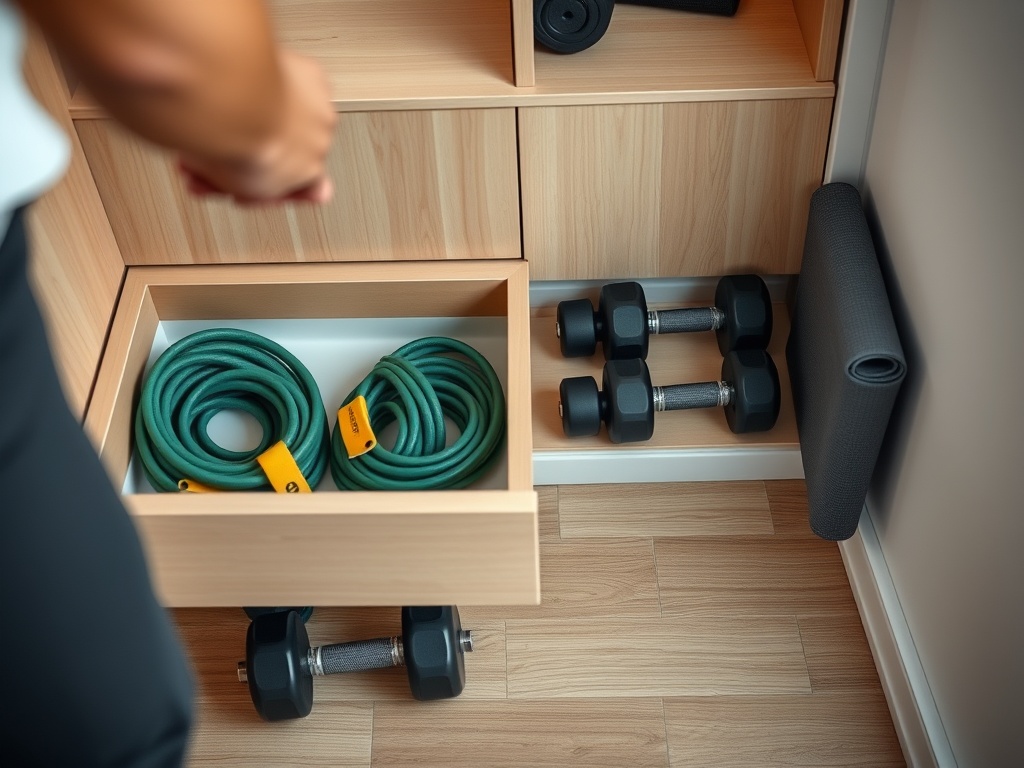
A home gym that takes ten minutes to assemble creates friction. Storage should be close to the training zone and simple enough that the equipment can be ready almost immediately.
Good options include a low bin under a sofa, a stable shelf for bands and small accessories, or a dedicated corner for adjustable dumbbells. Heavy objects belong low, not on high shelves. Avoid storing loaded equipment where it can roll into a walkway or fall during routine household movement.
This is also where behavior design matters. If you keep restarting plans that conflict with your schedule or home environment, What to Do When You Keep Setting Goals That Do Not Fit Your Life can help you reduce the setup burden rather than relying on motivation.
Design Sessions Around the Space You Have
Small-space training improves when the session is written to minimize transitions. Pair exercises that use the same equipment, or organize the session into blocks. For example, a dumbbell block might include a split squat, row, Romanian deadlift, and floor press before you put the dumbbells away.
For conditioning, you do not need to turn the apartment into an obstacle course. Brisk stair walking where permitted, outdoor walking, a compact bike, low-impact bodyweight circuits, or marching intervals can complement strength work. If you want a nutrition routine that is similarly practical outside the home, How to Build Better Restaurant Orders When You Want Healthier Options applies the same principle: simplify the decision before the busy moment arrives.
A Simple 20-Minute Layout Test
Before buying more gear, try this sequence with what you have:
1. Five minutes of low-intensity movement and dynamic mobility.
2. Three rounds of a lower-body movement, a push, and a pull.
3. Five minutes of easy-to-moderate continuous cardio or carries.
4. One minute to put everything away.
If the session repeatedly stalls because of insufficient resistance, unsafe positioning, or an exercise you cannot reproduce, you have identified a real equipment need. If the session works, the space is already functional.
Mistakes That Make Small Spaces Harder to Use
The most common errors are predictable: buying before measuring, choosing equipment that cannot be stored safely, using unstable furniture as a bench or anchor, creating a setup that blocks a doorway, and assuming more variety automatically improves training.
Another mistake is scaling load faster than the space can support. A heavier dumbbell may be appropriate for your muscles but inappropriate if you cannot move, rack, or set it down safely. Progress should include environmental control, not only heavier numbers.
Know When the Space Has Reached Its Limit
A compact setup is working when you can train consistently, progress one or more exercises, and start without reorganizing the apartment. You may need to scale up when your training goals require loads you cannot safely handle at home, specialized machines, substantial jumping or sprinting space, or coaching that is easier in person.
For now, choose one clear training zone, one versatile resistance tool, and one storage solution. Use them for several weeks before adding anything else. The best small-apartment fitness space is the one that repeatedly turns a few square feet into completed sessions.