The best breakfast-nook furniture uses less circulation space without making sitting, standing, or cleaning awkward. Wall-hugging banquettes, pedestal tables, drop-leaf tables, compact round tables, backless benches, and storage seating can all work. The right combination depends on whether your priority is maximum seating, flexible floor space, easier access, or hidden storage.
TL;DR: Start with movement, not furniture style. A banquette plus pedestal table usually saves the most chair-pull space. A small round table is flexible in tight corners. Drop-leaf tables suit multipurpose rooms. Storage benches add function but can become bulky if lids, drawers, or doors cannot open freely. Measure the occupied seating position, not just the empty furniture footprint.
Why breakfast nooks need different furniture logic
A breakfast nook is often squeezed between cabinets, windows, walls, doorways, or traffic routes. Standard dining sets assume generous clearance around all sides, but a compact nook cannot always support that. Space-saving furniture works by reducing one of three things: the amount of floor area occupied, the clearance needed to pull out a seat, or the number of separate pieces in the room.
The most successful layout still lets people sit down, stand up, carry food through the area, and clean the floor. If the table technically fits but traps the inside diner or blocks a cabinet door, the nook is not functioning well.
Compare the most useful furniture types
| Furniture type | Best for | Space advantage | Trade-off |
|---|---|---|---|
| Built-in banquette | Permanent compact nook | Eliminates chair-pull space along the wall | Fixed position and installation cost |
| Freestanding bench | Renters and flexible layouts | Seats several people with a narrow footprint | Less back support; may shift during use |
| Pedestal table | Banquettes and tight corners | No corner legs to trap knees or feet | Base size and stability vary |
| Round table | Small square or awkward nook | Easier circulation around corners | Less edge length for wall placement |
| Drop-leaf table | Multipurpose spaces | Shrinks when not in use | Hinges and supports need clear operating room |
| Storage banquette/bench | Small homes needing storage | Combines seating and concealed capacity | Heavier; access method can conflict with table placement |
| Nesting or folding chairs | Occasional extra seating | Can disappear when not needed | Less comfortable for everyday dining |
These are layout tools, not universal recommendations. Comfort, build quality, household mobility needs, and the frequency of use should decide the final mix.
Banquettes: strongest space saver for a fixed corner
A wall-hugging banquette removes the clearance normally needed to pull chairs backward. That makes it especially effective in a corner or along a narrow wall. Architectural Digest’s discussion of banquette seating highlights the same basic advantage: a banquette can fit more seating into a compact footprint and can sometimes include storage.
Built-ins make the cleanest use of an awkward recess because they can follow the exact wall dimensions. Freestanding banquettes are easier for renters and can move with you, though their legs or base may consume slightly more room.
Before committing, test the seat depth and table position. A bench that is too deep can push diners too far from the table, while a very upright back can feel uncomfortable during longer meals.
Pedestal tables improve leg freedom
A four-leg table can create a surprising amount of conflict in a small nook. Diners slide into the bench, knees meet corner legs, and chairs cannot tuck neatly. A center pedestal shifts support away from the corners, which is why pedestal tables pair so naturally with banquettes.
The base still matters. A wide disc or splayed base may interfere with feet even if it removes corner legs. Check the base diameter and compare it with the table top. For family use, stability is more important than squeezing in the smallest possible base.
If you want the nook to feel less crowded visually, a well-placed mirror for a small room can reflect light and extend the sightline without occupying floor area. A small-space style comparison can also help you decide how much visual detail the nook can comfortably carry.
Drop-leaf and gateleg tables for rooms that change jobs
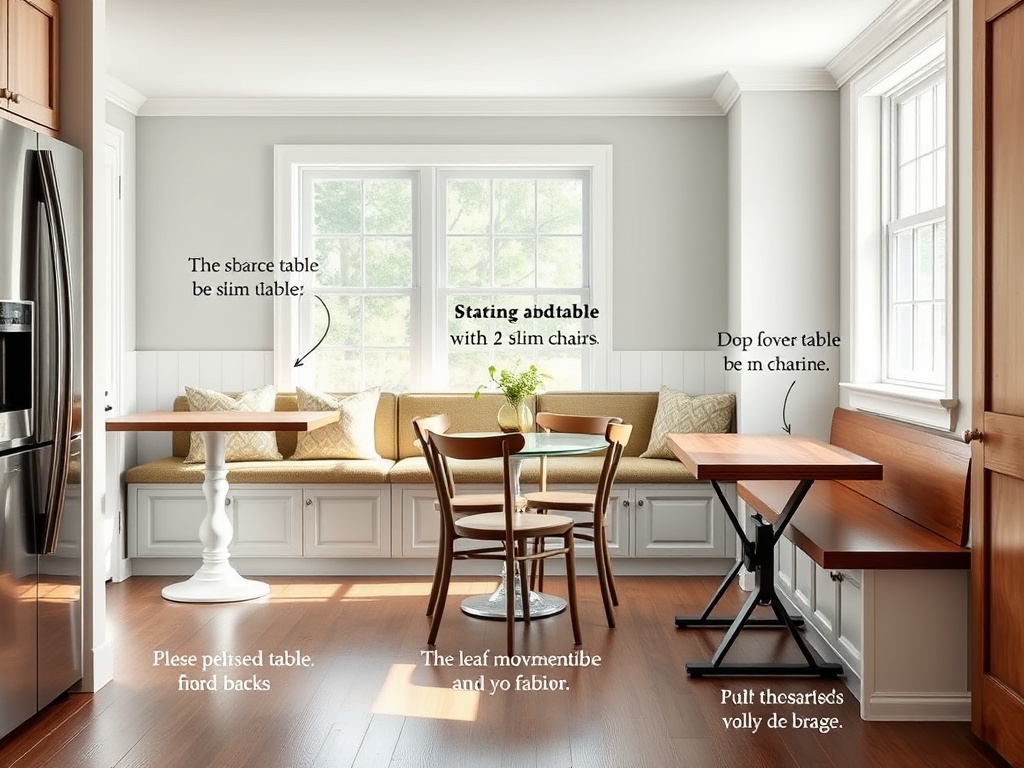
If the breakfast area doubles as a work zone, play area, or circulation path, a drop-leaf table can reduce its footprint between meals. One leaf can stay down against a wall while the other opens for daily use, or both can open when guests arrive.
Check the mechanism before buying. Some gateleg designs need a swinging support that requires floor clearance. Others use brackets that may be easier in a tight space. The table should feel stable when fully open and should not require awkward lifting around a bench.
A folding table is most useful when you genuinely need the floor back. If the table stays open every day, a simpler fixed table may be more durable and less visually busy.
Storage benches can earn their footprint twice
A breakfast nook often sits near the kitchen, where linens, small appliances, serving pieces, pet supplies, or seasonal items compete for cabinet space. A storage bench can put that underused volume beneath the seat to work.
Choose the access style carefully. Hinged lids are simple but may require moving cushions or sliding the table away. Front drawers are easier to open while the seat stays occupied, but they need clear floor space. Lift-up seats with soft-close hardware can be convenient, yet the lid weight and pinch points matter in homes with children.
If the bench includes tall side cabinets or other storage furniture, follow manufacturer anchoring instructions where applicable. The U.S. Consumer Product Safety Commission’s Anchor It guidance focuses particularly on tip-over risks from furniture such as bookcases and dressers. It does not mean every breakfast bench must be wall-anchored, but it is a useful reminder to treat tall or top-heavy storage pieces as safety equipment as well as decor.
Accessibility and comfort deserve a separate check
Households vary widely in mobility, reach, and transfer needs. Do not assume the tightest possible layout is the best one. Leave enough usable clear space for the people who will actually use the nook, and consider seat height, arm support, table-edge clearance, and approach direction.
The U.S. Access Board’s guidance on clear floor space is written for accessibility standards rather than as a blanket rule for private residential breakfast nooks. Still, its clear-space concepts can be a useful planning reference when accessibility is a priority. For a home project, local code and the user’s specific mobility needs should guide any formal requirements.
A simple shortlist by use case
- Maximum seating in a fixed corner: L-shaped banquette plus pedestal table.
- Renter-friendly nook: freestanding bench plus small round or pedestal table.
- Multipurpose room: drop-leaf table with stackable, folding, or nesting chairs.
- Storage-starved kitchen: storage banquette with front drawers or easy-access lift-up seats.
- Very narrow breakfast zone: wall bench plus slim rectangular or half-round table.
- Flexible entertaining: compact everyday table with stools or folding chairs stored elsewhere.
Measure the occupied layout before buying
Tape the table and seat footprints on the floor, then simulate people sitting down. Pull out chairs, open nearby cabinets, walk the normal kitchen route, and test how you would clean beneath the table. Furniture that passes that practical test will usually feel better than a set chosen only from dimensions on a product page.
Home design information is for general educational purposes. Furniture stability, wall anchoring, accessibility, electrical outlets, and local building requirements can vary. Follow manufacturer instructions and consult qualified professionals where installation or safety conditions require them.
For the next step, measure the nook at floor level and at tabletop height, then shortlist furniture by movement clearance first and style second.